Cracks in the Dome: Fractured Histories of Empire in the Zanzibar Museum, 1897-1964 by Sarah Longair
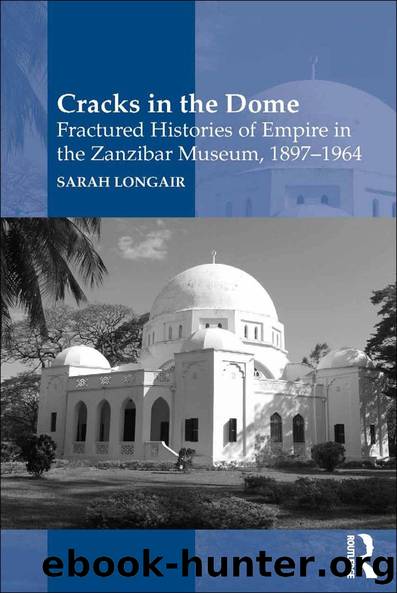
Author:Sarah Longair [Longair, Sarah]
Language: eng
Format: epub
Tags: History, Modern, 20th Century, Art, Museum Studies
ISBN: 9781317158769
Google: Cry1CwAAQBAJ
Publisher: Routledge
Published: 2016-03-09T01:26:54+00:00
4
Trusteeship of Culture: Acquisition and Display of the Museumâs Collection, 1925â1942
Ailsa Nicol Smith considered the preservation of âlocal art treasures and antiquitiesâ to be âpart of our trusteeshipâ. Her obligation therefore was to ensure the collection âshows and explains their culture, past and present, to the natives of the territoryâ.1 Her use of the term âtrusteeshipâ alludes to the ideology applied by the British Government to describe its responsibilities to its territories in the interwar period. It also relates to the practice of salvage ethnography â the justification by colonial powers that collecting objects preserved âdyingâ indigenous cultures.2 This chapter will explore trusteeship in the more specific context of acquiring and exhibiting the Zanzibar Museumâs collections.
Even though, as we have seen, the acquisition and display of objects in East Africa was not a new phenomenon, the deliberate construction of a museum collection of historical and ethnographic material was a novel exercise in Zanzibar. The intention to provide instruction guided the assemblage of material culture and natural history specimens. Chinese ceramics, for example, were not only a symbol of the cosmopolitanism or wealth of their owner; they now represented centuries of Zanzibarâs history and interaction with the wider world. British judgements of historical and anthropological value determined which narratives the objects symbolised. Yet, as this chapter will demonstrate, such interpretations of history were influenced by local ideas about Zanzibarâs past. This period also coincided with an increasing recognition of the aesthetic value of African objects in Europe.3
Few scholars have made reference to the Zanzibar Museumâs colonial-era display. Mark Horton, writing in 1992, gave a broad-ranging analysis of the Museum, which has formed the primary reference point for subsequent discussions of this collection:
Between 1925 and 1964 a very mixed collection was built up of artifacts, antiquities and items of biological interest ⦠with relatively little regard to theme or historical sequence; a cornucopia of miscellany. â¦
As with other African museums set up in the British period, the outlook and design of this new institution was heavily biased towards a colonial view of the past. Africa was seen as essentially culture-less; civilisation was introduced by outsiders. ⦠The displays were heavily biased to Zanzibarâs âinvadersâ be they Arab traders, Portuguese or British colonists or the ruling Buâsaidi sultanate. There were a limited number of ethnographic items, but these were inadequately displayed or explained.4
Sheriff, Voogt and Luhila offer a more recent analysis:
The design of the exhibits in the Peace Memorial Museum betrayed another colonial trait. The dominant perspective was anthropological rather than historical. Africa was not considered a historical continent, but, in line with social Darwinism of the times, as a laboratory for earlier forms of human civilisations. It had plenty of photographs and costumes âtypicalâ of the different ethnic groups in Zanzibar, emphasising their diversity rather than the process of homogenisation characteristic of the Swahili culture. The museumâs central rotunda featured the exploits of the colonisers and their agents, while the hexagonal wings were devoted to such themes as the arts, local industries, traditional beliefs, communication, etc.
Download
This site does not store any files on its server. We only index and link to content provided by other sites. Please contact the content providers to delete copyright contents if any and email us, we'll remove relevant links or contents immediately.
| Anthropology | Archaeology |
| Philosophy | Politics & Government |
| Social Sciences | Sociology |
| Women's Studies |
The Secret History by Donna Tartt(19096)
The Social Justice Warrior Handbook by Lisa De Pasquale(12191)
Thirteen Reasons Why by Jay Asher(8914)
This Is How You Lose Her by Junot Diaz(6890)
Weapons of Math Destruction by Cathy O'Neil(6282)
Zero to One by Peter Thiel(5804)
Beartown by Fredrik Backman(5759)
The Myth of the Strong Leader by Archie Brown(5510)
The Fire Next Time by James Baldwin(5450)
How Democracies Die by Steven Levitsky & Daniel Ziblatt(5219)
Promise Me, Dad by Joe Biden(5154)
Stone's Rules by Roger Stone(5088)
A Higher Loyalty: Truth, Lies, and Leadership by James Comey(4965)
100 Deadly Skills by Clint Emerson(4927)
Rise and Kill First by Ronen Bergman(4790)
Secrecy World by Jake Bernstein(4754)
The David Icke Guide to the Global Conspiracy (and how to end it) by David Icke(4720)
The Farm by Tom Rob Smith(4514)
The Doomsday Machine by Daniel Ellsberg(4491)
